Portrays the Arrival in Bethlehem of the Wise Men Carying Gifts for the Baby Jesus.

The biblical Magi [a] ( or ;[ane] singular: magus), too referred to as the (Iii) Wise Men or (Three) Kings, likewise the 3 Magi were distinguished foreigners in the Gospel of Matthew and Christian tradition. They are said to have visited Jesus subsequently his nascency, bearing gifts of gold, frankincense and myrrh. They are regular figures in traditional accounts of the birth celebrations of Christmas and are an important role of Christian tradition.
The Gospel of Matthew is the only one of the four canonical gospels to mention the Magi. Matthew reports that they came "from the east" to worship the "king of the Jews".[ii] The gospel never mentions the number of Magi. However, most western Christian denominations have traditionally assumed them to have been three in number, based on the statement that they brought three gifts.[3] In Eastern Christianity, especially the Syriac churches, the Magi oftentimes number twelve.[4] Their identification equally kings in later Christian writings is probably linked to Isaiah lx:ane–6, which refers to "kings [coming] to the brightness of your dawn" bearing "gold and frankincense".[5] Farther identification of the magi with kings may exist due to Psalm 72:11, "May all kings fall down earlier him".[6] [7]
Biblical account [edit]
Traditional nascence scenes depict iii "Wise Men" visiting the infant Jesus on the night of his nativity, in a manger accompanied past the shepherds and angels, merely this should be understood as an artistic convention allowing the two separate scenes of the Admiration of the Shepherds on the birth night and the later Admiration of the Magi to be combined for convenience.[eight] The unmarried biblical account in Matthew only presents an event at an unspecified bespeak after Christ's nativity in which an unnumbered party of unnamed "wise men" ( μάγοι , mágoi ) visits him in a firm ( οἰκίαν , oikian ),[9] not a stable, with only "his mother" mentioned equally nowadays. The New Revised Standard Version of Matthew 2:one–12 describes the visit of the Magi in this manner:
In the fourth dimension of King Herod, after Jesus was born in Bethlehem of Judea, wise men from the Eastward came to Jerusalem, request, "Where is the child who has been born king of the Jews? For nosotros observed his star at its rising, and have come to pay him homage." When King Herod heard this, he was frightened and all Jerusalem with him; and calling together all the chief priests and scribes of the people, he inquired of them where the Messiah was to be born. They told him, "In Bethlehem of Judea; for so information technology has been written by the prophet: 'And you lot, Bethlehem, in the country of Judah, are past no ways least amongst the rulers of Judah; for from y'all shall come a ruler who is to shepherd my people Israel.'" Then Herod secretly chosen for the wise men and learned from them the exact time when the star had appeared. And then he sent them to Bethlehem, saying, "Go and search diligently for the child; and when you have plant him, bring me word so that I may also get and pay him homage." When they had heard the king, they set out; and there, ahead of them, went the star that they had seen at its ascent, until information technology stopped over the identify where the child was. When they saw that the star had stopped, they were overwhelmed with joy. On entering the business firm, they saw the child with Mary his female parent; and they knelt down and paid him homage. Then, opening their treasure chests, they offered him gifts of gilded, frankincense, and myrrh. And having been warned in a dream not to return to Herod, they left for their own country past another path.
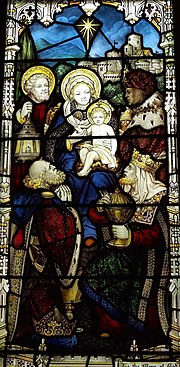
The text specifies no interval betwixt the birth and the visit, and creative depictions and the closeness of the traditional dates of Dec 25 and January vi encourage the popular assumption that the visit took place the same winter as the nativity, but later traditions varied, with the visit taken as occurring up to two winters after. This maximum interval explained Herod's control at Matthew ii:sixteen–xviii that the Massacre of the Innocents included boys upward to ii years old. More contempo commentators, not tied to the traditional feast days, may suggest a multifariousness of intervals.[x]
The wise men are mentioned twice presently thereafter in poetry 16, in reference to their abstention of Herod after seeing Jesus, and what Herod had learned from their before meeting. The star which they followed has traditionally become known as the Star of Bethlehem.
Clarification [edit]
The Magi are popularly referred to as wise men and kings. The give-and-take magi is the plural of Latin magus, borrowed from Greek μάγος ( magos ),[eleven] as used in the original Greek text of the Gospel of Matthew (in the plural: μάγοι , magoi ). Greek magos itself is derived from Old Persian maguŝ from the Avestan magâunô, i.e., the religious degree into which Zoroaster was built-in (run into Yasna 33.vii: "ýâ sruyê parê magâunô" = "then I can be heard across Magi"). The term refers to the Persian priestly degree of Zoroastrianism.[12] As part of their religion, these priests paid particular attention to the stars and gained an international reputation for astrology, which was at that fourth dimension highly regarded as a science. Their religious practices and use of astrology caused derivatives of the term Magi to exist applied to the occult in general and led to the English term magic. The King James Version translates the term as wise men; the same translation is applied to the wise men led by Daniel of earlier Hebrew Scriptures (Daniel two:48). The same discussion is given as sorcerer and sorcery when describing "Elymas the wizard" in Acts 13:6–eleven, and Simon Magus, considered a heretic by the early Church, in Acts 8:9–thirteen. Several translations refer to the men outright as astrologers at Matthew Chapter 2, including New English Bible (1961); Phillips New Testament in Modernistic English (J.B.Phillips, 1972); Twentieth Century New Testament (1904 revised edition); Amplified Bible (1958-New Testament); An American Translation (1935, Goodspeed); and The Living Bible (K. Taylor, 1962-New Attestation).
Although the Magi are commonly referred to equally "kings", there is zilch in the account from the Gospel of Matthew that implies that they were rulers of whatsoever kind. The identification of the Magi as kings is linked to Sometime Attestation prophecies that describe the Messiah being worshipped by kings in Isaiah 60:iii, Psalm 68:29, and Psalm 72:10, which reads, "Yea, all kings shall fall downwardly before him: all nations serve him."[13] [fourteen] [15] Early readers reinterpreted Matthew in light of these prophecies and elevated the Magi to kings. Past AD 500 all commentators adopted the prevalent tradition that the three were kings.[16] Later on Christian estimation stressed the adoration of the Magi and shepherds as the start recognition by the people of the earth of Christ as the Redeemer, only the reformer John Calvin was vehemently opposed to referring to the Magi equally kings. He wrote: "But the most ridiculous contrivance of the Papists on this subject is, that those men were kings... Across all doubt, they have been stupefied by a righteous judgment of God, that all might express mirth at [their] gross ignorance."[17] [18]
Names [edit]
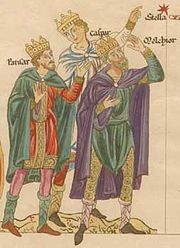
The New Testament does non give the names of the Magi. However, traditions and legends identify a variety of dissimilar names for them.[19] In the Western Christian church, they have all been regarded as saints and are commonly known as:
- Melchior (;[twenty] likewise Melichior),[21] a Persian scholar;
- Caspar ( or ;[22] also Gaspar, Jaspar, Jaspas, Gathaspa,[21] [23] and other variations);
- Balthazar ( or ;[24] too Balthasar, Balthassar, and Bithisarea),[21] a Babylonian scholar.
The online version of Encyclopædia Britannica states: "According to Western church tradition, Balthasar is often represented every bit a king of Arabia or sometimes Ethiopia, Melchior as a king of Persia, and Gaspar every bit a king of Republic of india."[25] These names evidently derive from a Greek manuscript probably composed in Alexandria effectually 500, and which has been translated into Latin with the title Excerpta Latina Barbari.[21] Another Greek document from the 8th century, of presumed Irish origin and translated into Latin with the title Collectanea et Flores, continues the tradition of three kings and their names and gives boosted details.[26] [27]

I candidate for the origin of the proper noun Caspar appears in the Acts of Thomas as Gondophares (21 – c. AD 47), i.east., Gudapharasa (from which "Caspar" might derive as corruption of "Gaspar"). This Gondophares declared independence from the Arsacids to get the kickoff Indo-Parthian male monarch, and he was allegedly visited by Thomas the Apostle. According to Ernst Herzfeld, his proper noun is perpetuated in the name of the Afghan city Kandahar, which he is said to have founded nether the name Gundopharron.[28]
In contrast, many Syrian Christians proper name the Magi Larvandad, Gushnasaph, and Hormisdas.[29]
In the Eastern churches, Ethiopian Christianity, for instance, has Hor, Karsudan, and Basanater, while the Armenian Catholics have Kagpha, Badadakharida and Badadilma.[xxx] [31] Many Chinese Christians believe that one of the magi came from China.[32]
Country of origin and journey [edit]
The phrase "from the east" ( ἀπὸ ἀνατολῶν , apo anatolon ), more literally "from the ascent [of the sunday]", is the only information Matthew provides most the region from which they came. The Parthian Empire, centered in Persia, stretched from eastern Syria to the fringes of India. Though the empire was tolerant of other religions, its dominant faith was Zoroastrianism, with its priestly magos grade.[33]
Although Matthew'southward business relationship does not explicitly cite the motivation for their journeying (other than seeing the star in the east, which they took to be the star of the Rex of the Jews), the Syriac Infancy Gospel provides some clarity by stating explicitly in the tertiary chapter that they were pursuing a prophecy from their prophet, Zoradascht (Zoroaster).[34]
There is an Armenian tradition identifying the "Magi of Bethlehem" every bit Balthasar of Arabia, Melchior of Persia, and Caspar of India.[35] Historian John of Hildesheim relates a tradition in the ancient silk road urban center of Taxila (in present-day Punjab, Pakistan) that 1 of the Magi passed through the city on the way to Bethlehem.[36]

Sebastian Brock, a historian of Christianity, has said: "Information technology was no doubt among converts from Zoroastrianism that... certain legends were developed around the Magi of the Gospels".[37] [38] And Anders Hultgård concluded that the Gospel story of the Magi was influenced past an Iranian fable concerning magi and a star, which was connected with Persian beliefs in the ascension of a star predicting the birth of a ruler and with myths describing the manifestation of a divine figure in fire and light.[39]
A model for the homage of the Magi might have been provided, it has been suggested, by the journey to Rome of Male monarch Tiridates I of Armenia, with his magi, to pay homage to the Emperor Nero, which took place in AD 66, a few years before the appointment assigned to the composition of the Gospel of Matthew.[xl] [41]
At that place was a tradition that the Central Asian Naimans and their Christian relatives, the Keraites, were descended from the biblical Magi.[42] This heritage passed to the Mongol dynasty of Genghis Khan when Sorghaghtani, niece of the Keraite ruler Toghrul, married Tolui, the youngest son of Genghis, and became the mother of Möngke Khan and his younger brother and successor, Kublai Khan. Toghrul became identified with the legendary Central Asian Christian male monarch Prester John, whose Mongol descendants were sought as allies confronting the Muslims by contemporary European monarchs and popes.[43] Sempad the Constable, elder brother of King Hetoum I of Cilician Armenia, visited the Mongol court in Karakorum in 1247–1250 and in 1254. He wrote a letter to Henry I Rex of Cyprus and Queen Stephanie (Sempad's sis) from Samarkand in 1243, in which he said: "Tanchat [Tangut, or Western Xia], which is the land from whence came the Iii Kings to Bethlehem to worship the Lord Jesus which was born. And know that the power of Christ has been, and is, so dandy, that the people of that land are Christians; and the whole country of Chata [Khitai, or Kara-Khitai] believes those Three Kings. I accept myself been in their churches and accept seen pictures of Jesus Christ and the Three Kings, one offering gilt, the second frankincense, and the third myrrh. And it is through those Three Kings that they believe in Christ, and that the Chan and his people accept now become Christians.[44] The legendary Christian ruler of Central Asia Prester John was reportedly a descendant of 1 of the Magi.[45]
Gestures of respect [edit]
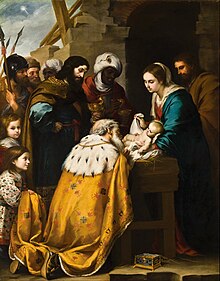
The Magi are described as "falling downward", "kneeling" or "bowing" in the worship of Jesus.[46] This gesture, together with Luke'due south birth narrative, had an important effect on Christian religious practices.[ citation needed ] They were indicative of dandy respect, and typically used when venerating a king. While prostration is at present rarely practised in the Westward it is yet relatively common in the Eastern Churches, especially during Lent. Kneeling has remained an important element of Christian worship to this mean solar day.
Traditional identities and symbolism [edit]
Apart from their names, the 3 Magi developed distinct characteristics in Christian tradition, so that betwixt them they represented the iii ages of (adult) human, three geographical and cultural areas, and sometimes other things. In i tradition, reflected in fine art past the 14th century (for example in the Arena Chapel by Giotto in 1305) Caspar is former, normally with a white beard, and gives the golden; he is "King of Tarsus, land of merchants" on the Mediterranean coast of modern Turkey, and is offset in line to kneel to Christ. Melchior is middle-aged, giving frankincense from Arabia, and Balthazar is a swain, very ofttimes and increasingly blackness-skinned, with myrrh from Saba (modernistic southern Republic of yemen). Their ages were often given as 60, twoscore and 20 respectively, and their geographical origins were rather variable, with Balthazar increasingly coming from Aksum or other parts of Africa, and being represented accordingly.[47] Balthazar's blackness has been the discipline of considerable recent scholarly attending; in art, it is found mostly in northern Europe, beginning from the 12th century, and becoming very common in the north past the 15th.[48] The subject of which king is which and who brought which gift is non without some variation depending on the tradition. The gift of gold is sometimes associated with Melchior likewise and in some traditions, Melchior is the former human being of the three Magi.[ citation needed ]
Gifts [edit]
3 gifts are explicitly identified in Matthew: aureate, frankincense and myrrh. In Koine Greek these are chrysós (χρυσός), líbanos (λίβανος) and smýrna (σμύρνα). Many different theories of the meaning and symbolism of the gifts take been brought forrad. While gilded is adequately obviously explained, frankincense, and particularly myrrh, are more than obscure. See the previous section for who gave which.
The theories generally pause downwards into two groups:
- All three gifts are ordinary offerings and gifts given to a king. Myrrh being commonly used as an anointing oil, frankincense as a perfume, and gold every bit a valuable.
- The three gifts had a spiritual meaning: gilt equally a symbol of kingship on earth, frankincense (an incense) as a symbol of deity, and myrrh (an embalming oil) as a symbol of death.
-
- This dates back to Origen in Contra Celsum: "gold, as to a king; myrrh, as to i who was mortal; and incense, equally to a God."[49]
- These interpretations are alluded to in the verses of the popular carol "We Three Kings" in which the magi describe their gifts. The last verse includes a summary of the estimation: "Glorious now behold Him arise/King and God and cede."
- Sometimes this is described more generally equally gold symbolizing virtue, frankincense symbolizing prayer, and myrrh symbolizing suffering.
-
Myrrh was used every bit an embalming ointment and as a penitential incense in funerals and cremations until the 15th century. The "holy oil" traditionally used by the Eastern Orthodox Church for performing the sacraments of chrismation and unction is traditionally scented with myrrh, and receiving either of these sacraments is ordinarily referred to equally "receiving the myrrh". The flick of the Magi on the seventh-century Franks Casket shows the 3rd visitor – he who brings myrrh – with a valknut over his back, a pagan symbol referring to Decease.[50]
It has been suggested past scholars that the "gifts" were medicinal rather than precious material for tribute.[51] [52] [53]
The Syrian Rex Seleucus I Nicator is recorded to take offered gold, frankincense and myrrh (amid other items) to Apollo in his temple at Didyma near Miletus in 288/7 BC,[54] and this may accept been the precedent for the mention of these three gifts in Gospel of Matthew (two:11). It was these three gifts, it is idea, which were the master cause for the number of the Magi becoming stock-still eventually at 3.[55]
This episode can exist linked to Isaiah 60 and to Psalm 72, which report gifts existence given by kings, and this has played a central office in the perception of the Magi as kings, rather than equally astronomer-priests. In a hymn of the tardily quaternary-century Hispanic poet Prudentius, the three gifts have already gained their medieval interpretation equally prophetic emblems of Jesus' identity, familiar in the carol "We Three Kings" by John Henry Hopkins, Jr., 1857.
John Chrysostom suggested that the gifts were fit to be given not merely to a rex simply to God, and contrasted them with the Jews' traditional offerings of sheep and calves, and accordingly Chrysostom asserts that the Magi worshiped Jesus as God.

What subsequently happened to these gifts is never mentioned in the scripture, but several traditions have developed.[56] 1 story has the gold beingness stolen by the two thieves who were later crucified alongside Jesus. Another tale has it being entrusted to and then misappropriated past Judas. One tradition suggests that Joseph and Mary used the gold to finance their travels when they fled Bethlehem afterwards an angel had warned, in a dream, about King Herod'due south programme to impale Jesus. And another story proposes the theory that the myrrh given to them at Jesus' nascency was used to anoint Jesus' body after his crucifixion.
In that location was a 15th-century aureate example purportedly containing the Souvenir of the Magi housed in the Monastery of St. Paul of Mount Athos. Information technology was donated to the monastery in the 15th century by Mara Branković, daughter of the Rex of Serbia Đurađ Branković, wife to the Ottoman Sultan Murat II and godmother to Mehmet Two the Conquistador (of Constantinople). After the Athens earthquake of September vii, 1999, they were temporarily displayed in Athens to strengthen faith and raise money for earthquake victims. The relics were displayed in Ukraine and Belarus in Christmas of 2014, and thus left Greece for the beginning time since the 15th century.[57]
Martyrdom traditions [edit]

The Three Wise Kings, Catalan Atlas, 1375, fol. V: "This province is called Tarshish, from which came the Three Wise Kings, and they came to Bethlehem in Judaea with their gifts and worshipped Jesus Christ, and they are entombed in the metropolis of Cologne ii days journeying from Bruges."
Christian Scriptures record nix well-nigh the biblical Magi subsequently reporting their going back to their own country (Matthew ii:12 uses the feminine singular noun, χώραν, noting 1 land, territory or region of origin). Two split up traditions take surfaced claiming that they were and then moved by their encounter with Jesus that they either became Christians on their own or were quick to convert fully upon afterwards encountering an Apostle of Jesus. The traditions claim that they were and so stiff in their beliefs that they willingly embraced martyrdom.
Chronicon of Dexter [edit]
1 tradition gained popularity in Kingdom of spain during the 17th century; it was plant in a work called the Chronicon of Dexter. The work was ascribed to Flavius Lucius Dexter the bishop of Barcelona, nether Theodosius the Keen. The tradition appears in the form of a simple martyrology reading, "In Arabia Felix, in the urban center of Sessania of the Adrumeti, the martyrdom of the holy kings, the three Magi, Gaspar, Balthassar, and Melchior who adored Christ."[58] Beginning appearing in 1610, the Chronicon of Dexter was immensely pop along with the traditions it independent throughout the 17th century. Later, this was all brought into question when historians and the Catholic bureaucracy in Rome declared the work a pious forgery.[59]
Relics at Cologne [edit]
A competing tradition asserts that the biblical Magi "were martyred for the organized religion, and that their bodies were first venerated at Constantinople; thence they were transferred to Milan in 344. It is sure that when Frederick I, Holy Roman Emperor (Barbarossa) imposed his authority on Milan, the relics there were transferred to Cologne Cathedral, housed in the Shrine of the Three Kings, and are venerated there today."[58] The Milanese treated the fragments of masonry from their at present-empty tomb as secondary relics and these were widely distributed effectually the region, including southern France, accounting for the frequency with which the Magi appear on chasse reliquaries in Limoges enamel.[60]
Tombs [edit]
There are several traditions on where the remains of the Magi are located, although none of the traditions is considered as an established fact or even as particularly likely by secular history. Marco Polo claimed that he was shown the iii tombs of the Magi at Saveh south of Tehran in the 1270s:
In Persia is the city of Saba, from which the Three Magi ready out when they went to worship Jesus Christ; and in this city they are buried, in three very big and beautiful monuments, next. And above them in that location is a foursquare edifice, advisedly kept. The bodies are still entire, with the hair and beard remaining.
Paul William Roberts provides some modernistic-day corroboration of this possibility in his book Journeying of the Magi.[61]

A Shrine of the Three Kings at Cologne Cathedral, co-ordinate to tradition, contains the basic of the Three Wise Men. Reputedly they were first discovered past Saint Helena on her famous pilgrimage to Palestine and the Holy Lands. She took the remains to the church building of Hagia Sophia in Constantinople; they were later moved to Milan (some sources say by the city'southward bishop, Eustorgius I[62]), earlier being sent to their current resting identify by the Holy Roman Emperor Frederick I in 1164. The Milanese celebrate their part in the tradition by holding a medieval costume parade every 6 January.
A version of the detailed elaboration familiar to us is laid out by the 14th-century cleric John of Hildesheim's Historia Trium Regum ("History of the Three Kings"). In accounting for the presence in Cologne of their mummified relics, he begins with the journeying of Helena, the female parent of Constantine I to Jerusalem, where she recovered the True Cross and other relics:

Queen Helen… began to think greatly of the bodies of these iii kings, and she arrayed herself, and accompanied by many attendants, went into the Land of Ind… later she had found the bodies of Melchior, Balthazar, and Gaspar, Queen Helen put them into 1 chest and ornamented information technology with groovy riches, and she brought them into Constantinople... and laid them in a church building that is chosen Saint Sophia.
Religious significance [edit]
The visit of the Magi is commemorated in most Western Christian churches by the observance of Epiphany, 6 January, which also serves as the banquet of the 3 as saints. The Eastern Orthodox celebrate the visit of the Magi on 25 December.
The Quran omits Matthew'southward episode of the Magi. Withal, the Persian Muslim encyclopaedist al-Tabari, writing in the 9th century, gives the familiar symbolism of the gifts of the Magi. Al-Tabari gave his source for the information to exist the afterwards seventh century Perso-Yemenite writer Wahb ibn Munabbih.[63]
Traditions [edit]
Holidays celebrating the inflow of the Magi traditionally recognise a distinction between the appointment of their arrival and the date of Jesus' birth. The account given in the Gospel of Matthew does not country that they were present on the night of the birth; in the Gospel of Luke, Joseph and Mary remain in Bethlehem until information technology is time for Jesus' dedication, in Jerusalem, and then return to their home in Nazareth.
Hispanic customs [edit]

The Three Wise Men receiving children at a shopping middle in Espana. Messages with souvenir requests are left in the letterbox on the left-hand side.
Western Christianity celebrates the Magi on the day of Epiphany, January 6, the day immediately post-obit the twelve days of Christmas, especially in the Spanish-speaking parts of the earth. In these areas, the Three Kings ( los Reyes Magos de Oriente , Los Tres Reyes Magos or simply Los Reyes Magos ) receive messages from children and so bring them gifts on the night before Epiphany. In Kingdom of spain, each 1 of the Magi is supposed to represent one unlike continent, Europe (Melchior), Asia (Caspar) and Africa (Balthasar). According to the tradition, the Magi come from the Orient on their camels to visit the houses of all the children, much like Sinterklaas and Santa Claus with his reindeer elsewhere, they visit everyone in ane night. In some areas, children set up a drink for each of the Magi. It is likewise traditional to prepare food and drink for the camels, because this is the only dark of the yr when they swallow.
In Espana, Argentina, Mexico, Paraguay and Uruguay, in that location is a long tradition of having the children receive presents by the three "Reyes Magos" on the nighttime of January 5 (Epiphany Eve) or morning of January six. Almost every Spanish urban center or boondocks organises cabalgatas in the evening, in which the kings and their servants parade and throw sweets to the children (and parents) in attendance. The cavalcade of the 3 kings in Alcoy claims to be the oldest in the world, having started in 1886. The Mystery Play of the Iii Magic Kings is also presented on Epiphany Eve. There is as well a "Roscón" (Spain) or "Rosca de Reyes" (Mexico) as explained beneath.
In the Philippines, behavior apropos the Three Kings (Filipino: Tatlóng Haring Mago, lit. "Three Magi Kings"; shortened to Tatlóng Harì or Spanish Tres Reyes) follows Hispanic influence, with the Feast of the Epiphany considered by many Filipinos as the traditional finish of their Christmas flavor. The tradition of the Three Kings' cabalgada is today done only in some areas, such as the old city of Intramuros in Manila, and the island of Marinduque. Some other dying custom is children leaving shoes out on Epiphany Eve, so that they may receive sweets and coin from the Three Kings. With the arrival of American culture in the early 20th century, the Three Kings every bit gift-givers accept been largely replaced in urban areas by Santa Claus, and they only survive in the greeting "Happy Three Kings!" and the surname Tatlóngharì. The 3 Kings are peculiarly revered in Gapan, Nueva Ecija, where they are enshrined as patron saints in the National Shrine of Virgen La Divina Pastora.[ citation needed ]
In nearly of this countries, children cut grass or greenery on January v and put it in a box under their bed or besides the christmas tree for the Kings' camels. Children receive gifts on January 6, which is called Día de Reyes, and is traditionally the day in which the Magi arrived begetting gifts for the Christ child. Christmas starts in December and ends in Jan subsequently Epiphany, although in Puerto Rico at that place are 8 more days of commemoration (las octavitas).
In 2009 a campaign started in Spain over the fact that Balthazar is normally played by a white person in blackface.[64] [ non-primary source needed ] [65] [ non-chief source needed ]
Cardinal Europe [edit]


Sternsinger – Christmas carolers in Sanok, Poland.
A tradition in Poland, Czech republic, Slovakia, Slovenia, and German-speaking Cosmic areas is the writing of the three kings' initials (C+Chiliad+B, C M B, G+K+B, K+K+B, in those areas where Caspar is spelled Kaspar or Gašper) above the main door of Catholic homes in chalk. This is a new year's approval for the occupants and the initials as well are believed to also stand for "Christus mansionem benedicat" ("May/Allow Christ Bless This House").[66] Depending on the city or town, this will be happen sometime betwixt Christmas and the Epiphany, with most municipalities jubilant closer to the Epiphany. Too in Catholic parts of the German language-speaking world, these markings are fabricated by the Sternsinger (literally, "star singers") – a group of children dressed upward as the magi.[67] The Sternsinger conduct a star representing the one followed by the biblical magi and sing Christmas carols equally they get door to door, such as "Stern über Bethlehem". An adult chaperones the group simply stays in the background of the performance. Afterward singing, the children write the three kings' initials on the door frame in exchange for charitable donations. Each year, German language and Austrian dioceses pick ane charity towards which all Sternsinger donations nationwide will be contributed.[ citation needed ] Traditionally, one child in the Sternsinger group is said to correspond Baltasar from Africa then, that child typically wears blackface makeup.[68] [69] [lxx] Many Germans do not consider this to exist racist because information technology is not intended to be a negative portrayal of a black person, but rather, a "realistic" or "traditional" portrayal of one.[71] The dialogue surrounding the politics of traditions involving greasepaint is not as developed as in Spain or the netherlands.[ commendation needed ] In the past, photographs of German politicians together with children in greasepaint accept caused a stir in English-language press.[72] [73] Moreover, Afro-Germans accept written that this apply of greasepaint is a missed opportunity to exist truly inclusive of Afro-Germans in German-speaking communities and contribute to the equation of "blackness" with "foreignness" and "otherness" in High german culture.[74]
In 2010 the twenty-four hours of Epiphany, Jan half dozen, was fabricated a holiday in Poland and thus a pre-war tradition was revived.[75] Since 2011, celebrations with biblical costuming have taken place throughout the country. For instance, in Warsaw at that place are processions from Plac Zamkowy downwards Krakowskie Przedmieście to Plac Piłsudskiego.[76]
Roscón de Reyes [edit]
In Spain and Portugal, a ring-shaped block (in Portuguese: bolo-rei [77]) contains both a small figurine of one of the Magi (or another surprise depending on the region) and a dry broad bean. The one who gets the figurine is "crowned" (with a crown made of cardboard or paper), but whoever gets the bean has to pay the value of the cake to the person who originally bought it. In Mexico they besides have the aforementioned ring-shaped block Rosca de Reyes (Kings Bagel or Thread) with figurines inside information technology. Whoever gets a figurine is supposed to organize and be the host of the family unit celebration for the Candelaria feast on February 2.
In France and Belgium, a cake containing a small effigy of the baby Jesus, known equally the "broad bean", is shared inside the family. Whoever gets the edible bean is crowned male monarch for the remainder of the vacation and wears a cardboard crown purchased with the cake. A similar practice is common in many areas of Switzerland, only the figurine is a miniature rex. The practice is known as tirer les Rois (Drawing the Kings). A queen is sometimes also chosen.
In New Orleans, Louisiana, parts of southern Texas, and surrounding regions, a like ring-shaped cake known every bit a "King Block" traditionally becomes available in bakeries from Epiphany to Mardi Gras. The baby Jesus figurine is inserted into the cake from underneath, and the person who gets the piece with the figurine is expected to buy or broil the side by side King Cake. At that place is wide variation among the types of pastry that may be called a King Cake, simply near are a baked cinnamon-flavoured twisted dough with thin frosting and additional sugar on top in the traditional Mardi Gras colours of gold, green and purple. To prevent adventitious injury or choking, the baby Jesus figurine is frequently not inserted into the cake at the baker, just included in the packaging for optional use past the buyer to insert information technology themselves. Mardi Gras-fashion beads and doubloons may be included as well.
In fine art [edit]

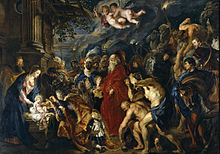
The Magi most frequently appear in European fine art in the Adoration of the Magi; less oftentimes in the Journey of the Magi has been a pop subject in art, and topos, and other scenes such as the Magi before Herod and the Dream of the Magi likewise announced in the Middle Ages. In Byzantine fine art they are depicted every bit Persians, wearing trousers and phrygian caps. Crowns appear from the 10th century. Despite being saints, they are very often shown without halos, perhaps to avoid distracting attending from either their crowns or the halos of the Holy Family. Sometimes only the lead rex, kneeling to Christ, has a halo the 2 others lack, probably indicating that the ii behind had not yet performed the act of worship that would ensure their status equally saints. Medieval artists also allegorised the theme to represent the three ages of man. Starting time in the 12th century, and very often by the 15th, the Kings also represent the three parts of the known (pre-Columbian) globe in Western art, specially in Northern Europe. Balthasar is thus represented equally a young African or Moor, and Caspar may be depicted with distinctly Oriental features.
An early Anglo-Saxon depiction survives on the Franks Casket (early 7th century, whalebone carving), the but Christian scene, which is combined with heathen and classical imagery. In its composition it follows the oriental style, which renders a ladylike scene, with the Virgin and Christ facing the spectator, while the Magi devoutly approach from the (left) side. Fifty-fifty amid non-Christians who had heard of the Christian story of the Magi, the motif was quite popular, since the Magi had endured a long journey and were generous. Instead of an angel, the picture places a swan-similar bird, perhaps interpretable equally the hero's fylgja (a protecting spirit, and shapeshifter).
Austrian artist Gottfried Helnwein depicted a more controversial tableau in his painting, Epiphany I: Adoration of the Magi (1996). Intended to represent the "many connections between the Third Reich and the Christian churches in Austria and Germany",[78] Nazi officers in uniform stand effectually an Aryan Madonna. The Christ toddler who stands on Mary's lap resembles Adolf Hitler.[79]
More than more often than not they announced in popular Nativity scenes and other Christmas decorations that have their origins in the Neapolitan diversity of the Italian presepio or Nativity crèche.
In music [edit]
Some Christmas carols refer to the biblical Magi or Iii Kings, particularly hymns meant to be sung by the star singers, such as "Stern über Bethlehem". Peter Cornelius equanimous a song bike Weihnachtslieder, Op. viii, which contain song "Die Könige" (The Kings), which became popular in an English choral organization, "The Three Kings". Balthazar, Caspar, and Melchior are also featured in Gian Carlo Menotti's 1951 opera Amahl and the Dark Visitors.
Run across besides [edit]
References [edit]
Notes
- ^ Koinē Greek: μάγοι, romanized: mágoi from Middle Persian moɣ(mard) from One-time Farsi magu- 'Zoroastrian chaplain'
Citations
- ^ Holman Illustrated Bible Lexicon. Nashville, Tennessee: Holman Bible Publishers. 2003. p. 1066. ISBN0-8054-2836-iv.
- ^ Matthew 2:1-two
- ^ Geza Vermes, The Birth: History and Legend, London, Penguin, 2006, p. 22
- ^ Metzger, 24 [80]
- ^ Isaiah 60:1-6
- ^ "Magi". Encyclopædia Britannica. Online Edition.
- ^ s.v. magi . Oxford English Lexicon (Third ed.). April 1910.
- ^ Schiller, 114
- ^ "Matthew 2". Bible Gateway.
- ^ Schiller, I, 96; The New Attestation by Bart D. Ehrman 1999 ISBN 0-19-512639-iv p. 109
- ^ Oxford English Dictionary, Third edition, April 2010, south.v. magus
- ^ Mary Boyce, A History of Zoroastrianism: The Early on Period (Brill, 1989, 2nd ed.), vol. 1, pp. 10–11 online; Mary Boyce, Zoroastrians: their religious beliefs and practices (Routledge, 2001, 2d ed.), p. 48 online; Linda Murray, The Oxford Companion to Christian Art and Architecture (Oxford University Press, 1996), p. 293; Stephen Mitchell, A History of the Later Roman Empire, AD 284–641: The Transformation of the Ancient Globe (Wiley–Blackwell, 2007), p. 387 online.
- ^ Psalm 72:11 (Rex James Version)
- ^ "Magi". Encyclopædia Britannica.
- ^ south.v. magi. Oxford English language Dictionary (Third ed.). Apr 1910.
- ^ Drum, Walter. "Magi." The Cosmic Encyclopedia. Vol. ix. New York: Robert Appleton Company, 1910. 24 December. 2016.
- ^ Ashby, Chad. "Magi, Wise Men, or Kings? It'south Complicated." Christianity Today, December sixteen, 2016.
- ^ Calvin, John. Calvin'southward Commentaries, Vol. 31: Matthew, Mark and Luke, Part I, tr. past John King . Retrieved 2010-05-fifteen . Quote from Commentary on Matthew 2:1–6
- ^ See Metzger, 23–29 for a lengthy account
- ^ "Melchior". Collins Dictionary. north.d. Retrieved 25 September 2014.
- ^ a b c d Excerpta Latina Barbari, folio 51B: "At that time in the reign of Augustus, on 1st Jan the Magi brought him gifts and worshipped him. The names of the Magi were Bithisarea, Melichior and Gathaspa.".
- ^ "Caspar or Gaspar". Collins Dictionary. n.d. Retrieved 25 September 2014.
- ^ Hugo Kehrer (1908), Vol. I, p. 70 Online version Kehrer's commentary: "Die Grade Jaspar stammt aus Frankreich. Sie findet sich im niederrheinisch-kölnischen Dialekt und im Englischen. Note: O. Baist page 455; J.P.Migne; Dictionnaire des apocryphes, Paris 1856, vol I, p. 1023. ... So in La Vie de St. Gilles; Li Roumans de Berte: Melcior, Jaspar, Baltazar; Rymbybel des Jakob von Märlant: Balthasar, Melchyor, Jaspas; ein altenglisches Gedicht des dreizehnten oder vierzehnten Jahrhunderts (13th century!!) Note: C.Horstmann, Altenglische Legenden, Paderborn 1875, p. 95; ... La Vie des trois Roys Jaspar Melchior et Balthasar, Paris 1498"-->]
- ^ "Balthazar". Collins Dictionary. northward.d. Retrieved 25 September 2014.
- ^ "Magi". Britannica.com . Retrieved 24 November 2021.
- ^ Hugo Kehrer (1908), Dice Heiligen Drei Könige in Literatur und Kunst (reprinted in 1976). Vol. I, p. 66. Online version. Quote from the Latin chronicle: primus fuisse dicitur Melchior, senex et canus, barba prolixa et capillis, tunica hyacinthina, sagoque mileno, et calceamentis hyacinthino et albo mixto opere, pro mitrario variae compositionis indutus: aurum obtulit regi Domino. ("the first [magus], named Melchior, was an old white-haired man, with a full beard and hair, [...]: the king gave gilded to our Lord.") Secundum, nomine Caspar, juvenis imberbis, rubicundus, mylenica tunica, sago rubeo, calceamentis hyacinthinis vestitus: thure quasi Deo oblatione digna, Deum honorabat. ("The 2nd, with name Caspar, a beardless boy, [... gave incense].") Tertius, fuscus, integre barbatus, Balthasar nomine, habens tunicam rubeam, albo vario, calceamentis inimicis amicus: per myrrham filium hominis moriturum professus est. ("The third one, nighttime-haired, with a full beard, named Balthasar, [... gave myrhh].") Omnia autem vestimenta eorum Syriaca sunt. ("The clothes of all [3] were Syrian-mode.")
- ^ Collectanea et Flores in Patrologia Latina. XCIV, page 541(D) Online version
- ^ Ernst Herzfeld, Archaeological History of Iran, London, Oxford University Printing for the British University, 1935, p. 63.
- ^ Witold Witakowski, "The Magi in Syriac Tradition", in George A. Kiraz (ed.), Malphono w-Rabo d-Malphone: Studies in Honor of Sebastian P. Brock, Piscataway (NJ), Gorgias Press, 2008, pp. 809–844.
- ^ Acta Sanctorum, May, I, 1780.
- ^ Apropos The Magi And Their Names.
- ^ Hattaway, Paul; Brother Yun; Yongze, Peter Xu; and Wang, Enoch. Back to Jerusalem. (Authentic Publishing, 2003). retrieved May 2007
- ^ Axworthy, Michael (2008). A History of Islamic republic of iran. Basic Books. pp. 31–43.
- ^ Hone, William (1890 (4th edit); 1820 (1st edition)). "The Counterfeit Books of the New Testament". Archive.org. Gebbie & Co., Publishers, Philadelphia. See: Retrieved 26 Jan 2017.
- ^ Nersessian, Vrej (2001). The Bible in the Armenian Tradition. Getty. ISBN978-0-89236-640-viii. [ folio needed ]
- ^ Historia Trium Regum (History of the Three Kings) past John of Hildesheim (1364–1375)[ specify ]
- ^ Brock, Sebastian (1982). "Christians in the Sasanian Empire: A Instance of Divided Loyalties". In Mews, Stuart (ed.). Religion and National Identity. Studies in Church History, 18. Oxford: Blackwell. pp. i–19. ISBN978-0-631-18060-9.
- ^ Ugo Monneret de Villard, Le Leggende orientali sui Magi evangelici, Citta del Vaticano, Biblioteca apostolica vaticana, 1952.[ page needed ]
- ^ Hultgård, Anders (1998). "The Magi and the Star—the Persian Groundwork in Texts and Iconography". In Schalk, Peter; Stausberg, Michael (eds.). 'Being Religious and Living through the Eyes': Studies in Religious Iconography and Iconology: A Celebratory Publication in Honour of Professor Jan Bergman. Acta Universitatis Upsaliensis: Historia Religionum, xiv. Uppsala, Almqvist & Wiksell International. pp. 215–25. ISBN978-91-554-4199-nine.
- ^ A. Dietrich, "Die Weisen aus dem Morgenlande", Zeitschrift für dice Neutestamentliche Wissenschaft, Bd. 3, 1902, p. 1 14; cited in J. Duchesne-Guillemin, "Die Drei Weisen aus dem Morgenlande und die Anbetung der Zeit", Antaios, Vol. Vii, 1965, pp. 234–252, 245; cited in Mary Boyce and Frantz Genet, A History of Zoroastrianism, Leiden, Brill, 1991, p. 453, n. 449.
- ^ Herzfeld, Ernst (1935). Archaeological History of Iran. Schweich Lectures of the British University. London: Oxford Academy Press. pp. 65–6. OCLC 651983281.
- ^ In regno Tarsae sunt tres provinciae, quarum dominatores se reges faciunt appellari. Homines illius patriae nominant Iogour. Semper idola coluerunt, et adhuc colunt omnes, praeter decem cognationes illorum regum, qui per demonstrationum stellae venerunt adorare nativitatem in Bethlehem Judae. Et adhuc multi magni et nobiles inveniunt inter Tartaros de cognatione illa, qui tenent firmiter fidem Christi. (In the kingdom of Tarsis in that location are three provinces, whose rulers accept called themselves kings. the men of that land are called Uighours. They always worshipped idols, and they all still worship them except for the 10 families of those Kings who from the appearance of the Star came to admire the Nativity in Bethlehem of Judah. And in that location are still many of the great and noble of those families constitute amidst the Tartars who hold firmly to the faith of Christ): Wesley Roberton Long (ed.), La flor de las ystorias de Orient by Hethum prince of Khorghos, Chicago, The University of Chicago Printing, 1934, pp. 53, 111, 115; cited in Ugo Monneret de Villard, Le Leggende orientali sui Magi evangelici, Citta del Vaticano, Biblioteca apostolica vaticana, 1952, p. 161. Hayton, Haithoni Armeni ordinis Praemonstratenis de Tartaris liber, Simon Grynaeus Johannes Huttichius, Novus orbis regionum ac insularum veteribus incognitarum, Basel, 1532, head 2, De Regno Tarsae, p. 420 "The people of these countrees be named Iobgontans [Uighurs], and at all tymes they haue been idolaters, and and so they contynue to this present solar day, save the nacion or kynred of those thre kynges which came to worshyp Our Lorde Ihesu Chryst at his natiuyte by demonstracyon of the sterre. And the linage of the same thre kynges be nonetheless vnto this twenty-four hour period slap-up lordes near the lande of Tartary, which ferme and stedfastly beleue in the fayth of Christ": Hetoum, A Lytell Cronycle: Richard Pynson's Translation (c. 1520) of La Fleur des Histoires de la Terre d'Orient, edited past Glenn Burger, Toronto, University of Toronto Press, 1988, Of the realme of Tharsey, p. eight, lines 29–38.
- ^ Friedrich Zarncke, "Der Priester Johannes", Abhandlungen der philologisch-historischen Classe der Koeniglichen Sachsischen Gesellschaft der Wissenschaften, Leipzig, Band 7, Heft 8, 1879, Southward.826–1028; Band I, Heft 8, 1883, South. 1–186), re-published in 1 book by G. Olms, Hildesheim, 1980.
- ^ Letter of Sempad the Constable to the King and Queen of Republic of cyprus, 1243, in Henry Yule, Mainland china and the Way Thither, Oxford, Hakluyt gild, 1866, Vol.I, pp. cxxvii, 262–3."
- ^ Fertur enim iste de antiqua progenie illorum, quorum in Evangelio mentio fit, esse Magorum, eisdemque, quibus et isti, gentibus imperans, tanta gloria et habundancia frui, ut non nisi sceptro smaragdino uti dicatur (It is reported that he is the descendant of those Magi of old who are mentioned in the Gospel, and to rule over the same nations as they did, enjoying such celebrity and prosperity that he uses no sceptre but one of emerald). Otto von Freising, Historia de Duabus Civitatibus, 1146, in Friedrich Zarncke, Der Priester Johannes, Leipzig, Hirzel, 1879 (repr. Georg Olms Verlag, Hildesheim and New York, 1980, p. 848; Adolf Hofmeister, Ottonis Episcopi Frisingensis Chronica; sive, Historia de Duabus Civitatibus, Hannover. 1912, p. 366.
- ^ "Matthew 2; – Passage Lookup – New International Version – Great britain". BibleGateway.com. Retrieved 2010-06-28 .
- ^ Penny, 401
- ^ Schiller, I, 113
- ^ Origen, Contra Celsum I.60.
- ^ "Franks Catafalque - F - panel (Front) - Pictures: The Magi".
- ^ Page, Sophie,"Magic In Medieval Manuscripts". University of Toronto Press, 2004. 64 pages. ISBN 0-8020-3797-6, p. 18.
- ^ Gustav-Adolf Schoener and Shane Denson [Translator], "Astrology: Between Religion and the Empirical".
- ^ "Frankincense: festive pharmacognosy Archived 2007-06-15 at the Wayback Automobile". Pharmaceutical periodical. Vol 271, 2003. pharmj.com.
- ^ Greek inscription RC 5 (OGIS 214) - English language translation. This inscription was in the past erroneously dated to about 243 B.C.
- ^ August Friedrich von Pauly et al., Realencyclopädie der Classischen Altertumswissenschaft, Vol. Sixteen, 1, Stuttgart, 1933, col.1145; Leonardo Olschki, "The Wise Men of the East in Oriental Traditions", Semitic and Oriental Studies, University of California Publications in Semitic Philology, Vol.xi, 1951, pp. 375 395, p. 380, n. 46; cited in Mary Boyce and Frantz Genet, A History of Zoroastrianism, Leiden, Brill, 1991, p. 450, northward. 438.
- ^ Lambert, John Chisholm, in James Hastings (ed.) A Dictionary of Christ and the Gospels. Page 100.
- ^ "Gifts of the Magi delivered to Minsk for worship". ITAR-TASS. 17 January 2014. Retrieved 2014-01-17 .
- ^ a b Andrew Edward Breen (February 1, 1908). A Harmonized Exposition of the Four Gospels, Volume 1. Rochester, New York.
- ^ R. R. Madden, M.D. (1864). "On certain Literary Frauds and Forgeries in Kingdom of spain And Italy". Proceedings of the Regal Irish Academy, Vol 8. Dublin.
- ^ Gauthier M-M. and François G., Émaux méridionaux: Catalogue international de l'oeuvre de Limoges – Tome I: Epoque romane, p. 11, Paris 1987
- ^ Journey of the Magi, Paul William Roberts, (2006) Tauris Parke Paperbacks, pgs 27-38
- ^ "Sant' Eustorgio I di Milano". Santiebeati.it. 2001-09-09. Retrieved 2010-06-28 .
- ^ "We, three kings of Orient were". Saudiaramcoworld.com. Archived from the original on 2010-01-13. Retrieved 2010-06-28 .
- ^ News well-nigh blackface Balthazars (in Castilian)
- ^ Vídeo enervating truthful black Baltazars (in Spanish)
- ^ "Christus Mansionem Benedicat « Catholic Sensibility". Catholicsensibility.wordpress.com. 2006-01-05. Retrieved 2012-01-12 .
- ^ "Duden | Sternsingen | Rechtschreibung, Bedeutung, Definition" (in German). Duden.de. 2012-10-thirty. Retrieved 2013-12-16 .
- ^ Name bedeutet: Gott schütze sein Leben (babylon.-hebr.) (2007-03-25). "Balthasar – Ökumenisches Heiligenlexikon". Heiligenlexikon.de. Retrieved 2013-12-16 .
- ^ "Catholic Encyclopedia: Baltasar". Newadvent.org. Retrieved 2013-12-sixteen .
- ^ "Greasepaint! Around the World". Blackness-face.com. Retrieved 2013-12-16 .
- ^ User-Kommentar von Dieter Schmeer. "Und dice Sternsinger? – Leser-Kommentar – FOCUS Online" (in German language). Focus.de. Archived from the original on 2013-12-03. Retrieved 2013-12-16 .
- ^ "German Chancellor Angela Merkel poses with children in blackface for Three King's Day celebration". NY Daily News. Retrieved 2013-12-xvi .
- ^ "Angela Merkel pictured with blacked-up children". Telegraph. 2013-01-04. Archived from the original on 2022-01-10. Retrieved 2013-12-sixteen .
- ^ Ogdan Ücgür (2012-01-06). "Sternsinger: Schwarzes Gesicht und weisse Hände". M-Media. Retrieved 2013-12-xvi .
- ^ "Trzech_Kroli_juz_swietem_panstwowym.html Trzech Króli już świętem państwowym (Three Kings already a public holiday". Archived from the original on 2016-11-21. Retrieved 2016-11-21 .
- ^ "Orszak Trzech Króli | Warszawa". Orszak.org. 2013-01-01. Archived from the original on 2013-04-fifteen. Retrieved 2013-07-04 .
- ^ À mesa com o tradicional Bolo-rei – Uma instituição nacional Archived 2010-06-01 at the Portuguese Spider web Archive Matosinhos Hoje, 6 January 2010.
- ^ Baker, Kenneth (ix August 2004). "Dark and detached, the art of Gottfried Helnwein demands a response". San Francisco Chronicle. accessed with EBSCOHost.
- ^ Denver Art Museum, Radar, Selections from the Collection of Vicki and Kent Logan, Gwen F. Chanzit, 2006 [1] Archived 2008-06-09 at the Wayback Machine
Bibliography
- Giffords, Gloria Fraser, Sanctuaries of Earth, Stone, and Light: The Churches of Northern New Espana, 1530–1821, 2007, University of Arizona Press, ISBN 0816525897, 9780816525898, google books
- Metzger, Bruce, New Testament Studies: Philological, Versional, and Patristic, Volume x, 1980, BRILL, ISBN 9004061630, 9789004061637.
- Penny, Nicholas, National Gallery Catalogues (new series): The Sixteenth Century Italian Paintings, Volume II, Venice 1540–1600, 2008, National Gallery Publications Ltd, ISBN 1857099133
- Schiller, Gertud, Iconography of Christian Fine art, Vol. I, 1971 (English trans from German), Lund Humphries, London, ISBN 0853312702
Further reading
- Albright, W. F., and C. S. Mann. "Matthew." The Ballast Bible Serial. New York: Doubleday & Visitor, 1971.
- Becker, Alfred: Franks Casket. Zu den Bildern und Inschriften des Runenkästchens von Auzon (Regensburg, 1973) pp. 125–142, Ikonographie der Magierbilder, Inschriften.
- Benecke, P. V. M. (1900). "Magi". In James Hastings (ed.). A Lexicon of the Bible. Vol. III. pp. 203–206.
- Brown, Raymond E. The Birth of the Messiah: A Commentary on the Infancy Narratives in Matthew and Luke. London: Thousand. Chapman, 1977.
- Clarke, Howard W. (2003). The Gospel of Matthew and its Readers: A Historical Introduction to the First Gospel. Bloomington: Indiana University Press.
- Chrysostom, John. "Homilies on Matthew: Homily VI". c. quaternary century.
- France, R. T. The Gospel According to Matthew: An Introduction and Commentary. Leicester: Inter-Varsity, 1985.
- Gundry, Robert H. Matthew: A Commentary on his Literary and Theological Art. Grand Rapids: William B. Eerdmans Publishing Visitor, 1982.
- Hegedus, Tim (2003). "The Magi and the Star in the Gospel of Matthew and Early Christian Tradition". Laval Théologique et Philosophique. 59 (1): 81–95. doi:10.7202/000790ar.
- Loma, David. The Gospel of Matthew. Thou Rapids: Eerdmans, 1981
- Lambert, John Chisholm, A Dictionary of Christ and the Gospels. Folio 97–101.
- Levine, Amy-Jill. "Matthew." Women'south Bible Commentary. Carol A. Newsom and Sharon H. Ringe, eds. Louisville: Westminster John Knox Press, 1998.
- Molnar, Michael R., The Star of Bethlehem: The Legacy of the Magi. Rutgers Academy Press, 1999. 187 pages. ISBN 0-8135-2701-five
- Powell, Mark Allan. "The Magi as Wise Men: Re-examining a Basic Supposition." New Testament Studies. Vol. 46, 2000.
- Schweizer, Eduard. The Good News According to Matthew. Atlanta: John Knox Press, 1975.
- Trexler, Richard C. Journeying of the Magi: Meanings in History of a Christian Story. Princeton University Press, 1997.
- Watson, Richard, A Biblical and Theological Dictionary, Page 608–611.
External links [edit]
- Mark Rose, "The Iii Kings & the Star": the Cologne reliquary and the BBC pop documentary
- Alfred Becker, Franks Casket
- Caroline Stone, "We 3 Kings of Orient Were"
- Magi Cosmic Encyclopedia
- "Procession of the 3 Kings in Valencia"
Source: https://en.wikipedia.org/wiki/Biblical_Magi
0 Response to "Portrays the Arrival in Bethlehem of the Wise Men Carying Gifts for the Baby Jesus."
Post a Comment